

At a glance
- UHMWPE liners control abrasive wear by providing a sacrificial surface that protects parent steel, reducing accelerated wear in primary flow paths.
- They manage peak impact stress from heavy or uneven aggregates, limiting localised damage at loading, drop and discharge points.
- Their low-friction surfaces support clean, predictable discharge under high load, even when fines, moisture or variable particle sizing are present.
- UHMWPE liners remain dimensionally stable under sustained aggregate loads when correctly specified and supported.
Heavy aggregates such as crushed rock, road base, gravel and similar materials impose continuous stress on bulk-handling equipment used in construction, transport, quarry processing and road infrastructure.
As material moves through trays, chutes and hoppers, sliding contact causes abrasive wear, while uneven particle distribution concentrates impact at loading and tipping points. Fines and moisture further restrict movement, impacting clean discharge and increasing maintenance demand.
Liners are used not only to protect equipment but also to influence material flow behaviour when carrying heavy loads and to stabilise performance across repeated duty cycles. UHMWPE liners are chosen for heavy aggregate handling because their material properties address abrasion, impact and sustained load pressure while supporting reliable material flow.
This article explains how UHMWPE liners address the challenges faced in operations handling heavy aggregate loads.
Controls Abrasive Wear From Continuous Heavy Aggregate Contact
Heavy aggregates slide and grind across tray floors and side walls during repeated transport and tipping cycles. Continuous contact with coarse, angular particles progressively wears and thins the steel surface.
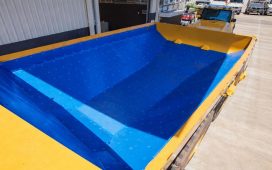
UHMWPE liners control this wear by forming a sacrificial protective layer between the abrasive load and the tray. The liner takes the abrasive wear at its surface, reducing direct steel-to-aggregate contact. Lower surface friction also reduces snagging and gouging, allowing material to move freely and reducing wear over time.
By limiting progressive steel wear, abrasion-resistant UHMWPE liners help maintain tray thickness and structural integrity over longer service periods, reducing the likelihood of exposed steel, fatigue-related damage and tray failures that require repair or replacement in high-abrasion environments.
Reduces Impact Damage From Heavy and Uneven Aggregates
Heavy aggregate loading and tipping place sudden impact forces on handling equipment. Aggregates drop and strike hard-contact surfaces at loading points, drop zones, and deflection areas. Larger or uneven pieces tend to hit the same spots repeatedly, concentrating stress and gradually denting and deforming the steel tray.
UHMWPE liners manage these loads by limiting the transfer of impact stress into the parent structure. Rather than applying force directly to the steel, the liner deforms locally, absorbs impact energy and reduces peak stress concentrations in high-impact contact zones.
By absorbing repeated impacts at these high-stress locations, UHMWPE liners limit denting, localised surface deformation and accelerated wear, helping protect both the liner and the underlying steel structure during ongoing heavy aggregate handling.
Supports Reliable Discharge Under High Aggregate Weight
As aggregate loads increase, pressure at the tray surface rises. Where particle sizes vary, and fines fill voids between larger particles, this pressure increases friction at the contact surface, causing material to bind or hang up rather than release cleanly.
UHMWPE liners reduce friction at the point of contact between the load and the tray. With lower friction at the liner surface, aggregates slide more freely, resulting in cleaner, more consistent discharge. In road construction equipment and other industrial applications, this helps reduce carryback and uneven material release.
With discharge less affected by interface friction, reliance on steep tipping angles, vibration or repeated intervention is reduced.
Maintains Stability Under Sustained Aggregate Loads
In many applications, aggregates remain in contact with liner surfaces for extended periods during transport or storage. This creates a sustained static load rather than short, intermittent forces.
UHMWPE liners are designed to maintain alignment and fit under sustained load when correctly specified and supported. This stability is critical in trays, bins and storage systems where liner movement or deformation can create uneven flow surfaces, disrupting discharge and accelerating localised wear.
By maintaining shape and alignment under load, UHMWPE liners support reliable long-term performance.
UHMWPE liners handle heavy aggregate loads by aligning material properties with the mechanical stresses encountered during loading, transport and tipping cycles. Abrasion is managed at the liner surface rather than the parent steel, impact stress is controlled at high-load contact points, discharge remains predictable under heavy loads, and liner alignment is maintained under sustained pressure.
Premium-grade UHMWPE liners, such as OKUSLIDE®, apply these principles in a purpose-engineered format for aggregate-handling operations. In practice, this results in more predictable wear behaviour, reduced maintenance requirements in high-stress areas, and more consistent discharge performance across repeated operating cycles.
Where heavy aggregates impose ongoing stress on trays, chutes and storage systems, selecting an appropriately specified UHMWPE liner is a practical step toward improving reliability throughout the equipment’s full operating life.